The Price of Singular: An Honest Reckoning With What It Truly Costs to Own a Vehicle Built for No One Else
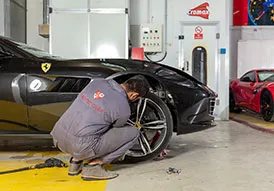
Photo: rare exotic luxury car in private garage with mechanic specialist service inspection, via exoticcars.ae
There is a particular kind of satisfaction that comes with owning something the rest of the world cannot easily replicate. For automotive enthusiasts, that satisfaction often takes the form of a vehicle produced in limited numbers, optioned in a configuration that borders on unique, or preserved in a condition that places it in a category of its own. The acquisition story is frequently compelling. The ownership story that follows is, in many cases, considerably more complicated.
This piece does not exist to discourage the pursuit of rare vehicles. On the contrary—we believe deeply in the value of preserving and celebrating automobiles that represent the outer edges of what manufacturers dared to build. But intellectual honesty demands that prospective owners enter this world with eyes fully open to its demands. The romance of singular ownership and the reality of it are not always the same story.
Parts Availability: The First and Most Persistent Challenge
When a vehicle is produced in large numbers, the aftermarket responds accordingly. Millions of replacement parts are manufactured, warehoused, and distributed through channels that make a Saturday morning repair feel almost routine. When a vehicle exists in hundreds of examples rather than hundreds of thousands, that ecosystem either never develops or quietly collapses as demand fails to justify the economics of production.
Consider a low-volume European sports car from the early 1990s. Its manufacturer may have produced fewer than 2,000 units for the North American market. Thirty years later, many of those vehicles have been totaled, parted out, or simply lost to time. The remaining pool of owners competes for a fixed—and slowly diminishing—supply of original components. A single interior trim piece, a specific sensor, or a proprietary electronic module can take months to source, and when found, commands a price that reflects scarcity rather than intrinsic value.
This dynamic affects vehicles at every price point. A rare factory-optioned American muscle car may require a carburetor assembly that was produced for only one model year in a specific displacement configuration. A limited-edition Japanese sports car may need a transmission component that was never sold separately from the complete unit. The search for these parts is not merely inconvenient—it is genuinely time-consuming and financially unpredictable.
Specialized Service: Finding the Right Hands
Equally significant is the question of who, exactly, is qualified to work on a vehicle outside the mainstream service ecosystem. Dealerships are generally equipped to service the vehicles they sell new. A franchise store that no longer carries a discontinued brand, or that has turned over its technical staff entirely, may possess neither the diagnostic equipment nor the institutional knowledge to address a problem specific to a rare configuration.
Independent specialists exist for virtually every marque of consequence, and for many obscure ones. In major metropolitan areas—Los Angeles, Chicago, Miami, New York—finding a competent independent technician for an unusual European or Japanese vehicle is achievable with reasonable effort. In smaller markets, the nearest qualified shop may be several hundred miles distant. For a vehicle that cannot be driven in its current condition, that distance translates directly into transport costs, extended timelines, and the particular frustration of entrusting something irreplaceable to a shipping company.
The cost of specialized labor compounds the parts challenge. A technician with genuine expertise in a rare vehicle's systems commands a premium hourly rate that reflects the scarcity of that expertise. A job that might cost $400 at a general independent shop can cost two or three times that amount at a specialist facility—assuming one is available within a practical distance.
Insurance: Valuing What Cannot Easily Be Replaced
Standard auto insurance policies are designed around the concept of actual cash value—a figure derived from market comparables that assumes a broad pool of similar vehicles against which to measure. For a vehicle that exists in small numbers, that comparable pool is thin, and the resulting valuation may bear little relationship to what a knowledgeable buyer would actually pay.
Agreed-value insurance policies, offered by specialty carriers such as Hagerty, Grundy, and American Collectors, address this problem by establishing a fixed insured value at the time the policy is written, typically based on a formal appraisal. For rare and collectible vehicles, this approach is essentially mandatory. It is also more expensive than standard coverage, and it often comes with usage restrictions—annual mileage caps, storage requirements, and limitations on primary-use driving—that may conflict with an owner's intention to actually drive the car.
The appraisal process itself merits attention. A credible appraisal for a genuinely rare vehicle requires an appraiser with specific expertise in that vehicle's market segment. A general automotive appraiser may lack the reference points to accurately value a low-production variant. An under-appraisal leaves an owner financially exposed in the event of a total loss. An over-appraisal inflates premiums without providing additional security if the insurer disputes the value at claim time.
Long-Term Value: The Case For and Against
The financial argument for owning rare vehicles rests on the premise that scarcity tends to preserve or appreciate value over time, particularly as the population of surviving examples contracts. For the most significant vehicles—documented low-production variants, factory-special-order configurations, vehicles with unbroken ownership histories—this argument has historical support. Certain categories of rare American muscle, European exotics, and limited-run Japanese performance cars have delivered returns that compare favorably with conventional investments over multi-decade holding periods.
The counterargument is that this outcome is neither guaranteed nor universal. Many rare vehicles appreciate only within a narrow community of enthusiasts whose interest may not sustain across generational shifts in taste. A vehicle that commands a premium among a cohort of fifty-year-old collectors today may face a smaller, less financially robust audience in twenty years. Liquidity—the ability to convert the asset to cash at a fair price within a reasonable timeframe—is also genuinely limited for vehicles with thin markets.
Ownership costs over that holding period must also be factored honestly. A vehicle that requires $15,000 in parts and service over ten years, plus premium insurance, plus occasional specialized transport, has a very different net return profile than one that simply appreciated on paper.
The Honest Conclusion
Owning a rare vehicle is, for the right person, one of the most rewarding experiences the automotive world offers. The connection to something built with uncommon intention, preserved against the odds, and understood by a small community of genuinely passionate people carries a value that no spreadsheet captures cleanly.
But that reward is earned, not merely purchased. It requires a willingness to invest time in research, to build relationships with specialists, to accept logistical complexity as a feature of the ownership experience rather than a defect in it, and to approach the financial realities with the same rigor one would apply to any significant asset.
At Only One Auto, we present rare and singular vehicles with full transparency about what they are and what they require. We believe the right vehicle in the right owner's hands is a genuinely excellent outcome—and that outcome begins with an honest accounting of what singular ownership truly demands.